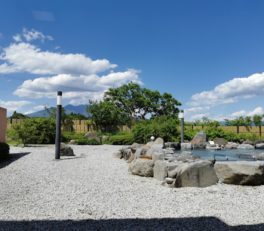
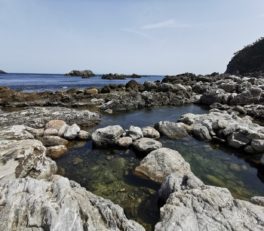
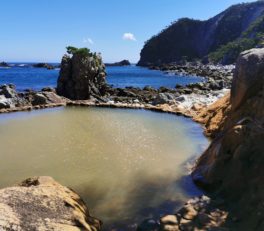
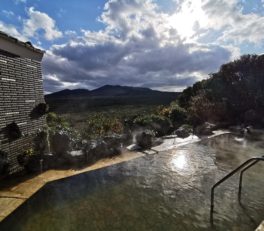
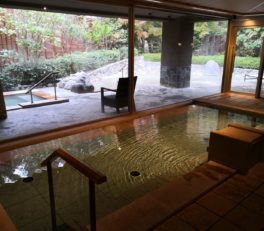
After climbing Mt. Mizugaki, a strange looking mountain with a forest of rocky peaks, I headed to Masutomi-no-yu in Masutomi Onsen. Around here, Foro-kaku is probably the most famous with many therapeutic bathers seeking the benefits of radium hot spring. But unfortunately it is only for overnight guests. Since it was a day-trip onsen after mountain climbing, I went to Masutomi-no-yu, a day trip onsen facility.
Continue readingCategory: Kanto
Yubiso Onsen – Nakaya Ryokan
On the way back from hiking trip to see Ichinokurasawa, the world-famous steep cliff of Mt. Tanigawa, I stopped by Yubiso Onsen. I noticed this small Yubuso Onsen while heading to Ichinokurasawa, so I was thinking about visiting here on the way back. Although most of the inns were closed for day-trip onsen due to the COVID-19, Nakaya Ryokan was probably the only one which was open today.
Continue readingKai-Komagatake Onsen – Ojira-no-yu
On the way back from a hike (more of a climb than a hike) in the Ojiragawa valley, which was much harder than I expected, I stopped by the Ojira-no-yu attached to the campground. I didn’t have much expectation, but I was betrayed in a good way by the open-air bath with no roof and a pleasant feeling, and the reddish brown hot spring with surprisingly dense ingredients.
Continue readingAshitsuki Onsen in Shikine island
Unlike Jinata Onsen and Sankai-no-yu, Ashitsuki Onsen has a rather solidly formed bathtub, and the hot spring is not reddish brown. The spring quality, however, is the same sodium chloride spring. According to the information board, the “Guide to the Seven Islands of Izu” written around the 12th year of the Kansei Era, stated that “if you take good care of yourself in the hot springs of Shikine island, your skin will be healed…”. This is why it’s called “surgical hot spring” while Jinata Onsen is called “internal medicine hot spring”.
Continue readingSankai-no-yu in Shikine island
When it comes to hot springs in Shikine island, most of them mention the following four: “Jinata Onsen”, “Ashitsuki Onsen”, “Matsugashita Miyabi-yu”, and “Ikoi-no-ie”. But I heard that there is another hot spring near Ashitsuki Onsen called “Funaritto-no-yu” or “Sankai-no-yu”, and I was curious, so I looked for it.
Continue readingJinata Onsen in Shikine island
The onsen that I saw in the guide book was located in a dynamic location bordering the ocean, and I wondered if it was really a hot spring. It said it is a hidden hot spring called Jinata Onsen, located in Shikine island. I wanted to visit someday, but the source of the hot spring is so hot that you can’t get in unless the tide is rising to some extent. In addition, it’s a remote island with limited transportation, and depending on the weather, I may not even be able to land. So I thought I’d need to stay a few days.
Continue readingMatsugashita Miyabi-yu in Shikine island
The famous Jinata Onsen, Ashitsuki Onsen, and Sankai-no-yu in Shikine island are all affected by the flow of the tide, so there are restrictions on when you can enter them. But Matsugashita Miyabi-yu is an artificial open-air bath that is unaffected by the flow of the tide. Even though it’s artificial, as you can see, the view from the hot spring is outstanding.
Continue readingMihara-yama Onsen – Oshima Hot Spa Hotel
The Oshima Hot Spa Hotel in Mihara-yama Onsen is one of my favorite hot spring in Oshima, as it is easily accessible from the center of Tokyo and has many attractions, as well as an open-air bath with an outstanding view. It’s a simple hot spring with a slight yellowish color, perfect for relieving fatigue after a long day hiking.
Continue readingMamashita Onsen
I’ve always wanted to visit Niijima, and I heard there’s a sand bath there. So, I decided to go and enjoy some sightseeing too! Mamashita Onsen is located close to the port and features a natural hot spring with a temperature of nearly 80°C. The water is classified as a sodium chloride strong saline spring. The facility offers both regular hot spring baths, including outdoor baths, and sand baths.
Continue readingHakone-Hisui
With so many hotels and ryokan to choose from in Hakone, one of my favorites is Hakone Hisui. Hakone is famous for its hot springs, and at Hakone Hisui, you can enjoy two types of baths: the milky, sulfur-rich water sourced from Owakudani, and the clear, gentle Ubako spring water.
Continue reading