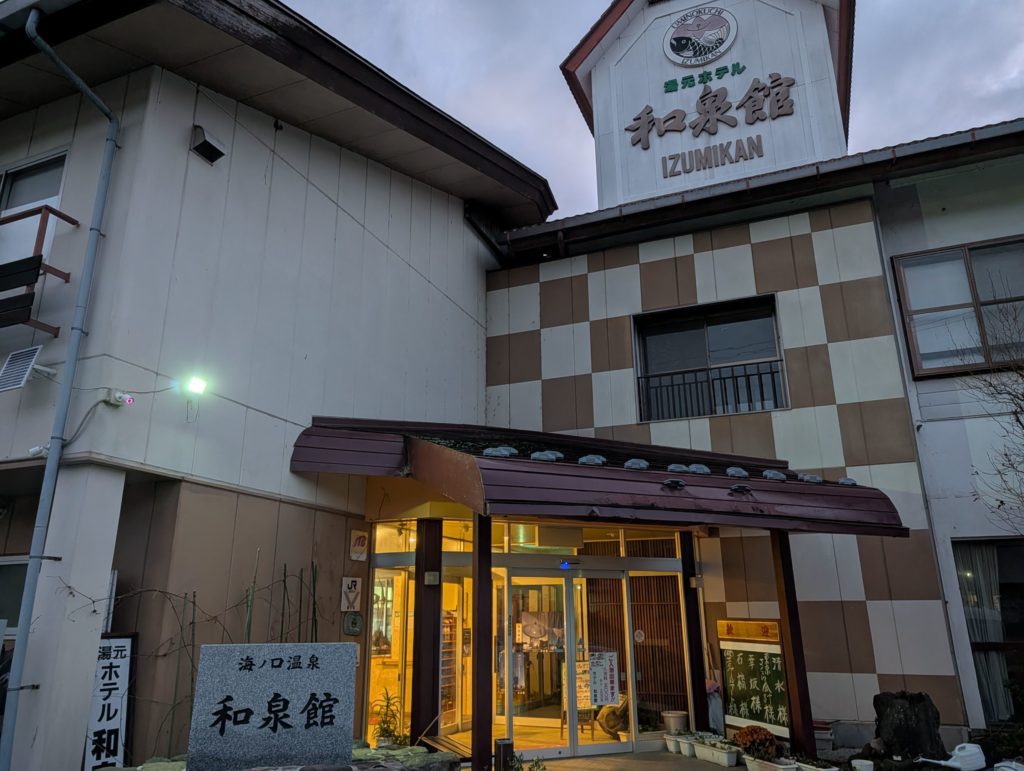
[Access] About 5 minutes walk from Saku Uminokuchi Station on JR Koumi Line
[Webpage] Yumoto Hotel Izumi-kan (Japanese)
After finishing a day hike up Mt. Kobushigatake, I looked around to see if there might be a good hot spring near the trailhead at Moukidaira. Unfortunately, there were no onsen nearby, and even heading down the prefectural road toward Kawakami or Nobeyama didn’t seem very promising. Just as I was starting to give up, I spotted Uminokuchi Onsen Gensen on Google Maps. It looked amazing—but some posts said it had already become a ruin. Still, on closer inspection, it seemed that a nearby inn called Izumikan was offering day-use bathing, so I decided to check it out.

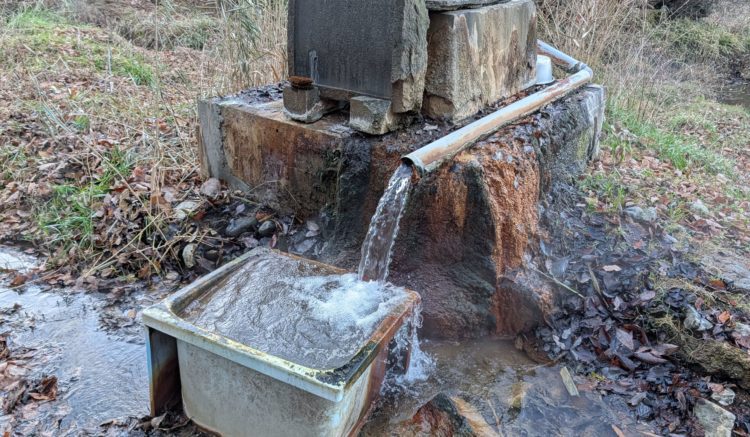
Just beyond Izumikan, I found the spot shown in the photo above, where hot spring water gushes directly from the source. Mineral deposits clung thickly to the rocks, giving it a wonderfully rustic feel. Judging from the steam, it didn’t seem boiling hot, so I cautiously touched the water—it was pleasantly warm. If only there were a bath using this source water as-is, I thought—it would be perfect.
A little farther past the source, just as Google Maps reviews suggested, stood the remains of an abandoned inn. The atmosphere in the photos was quite appealing, which made it all the more disappointing. With that, I headed back and made my way into Izumikan.
Uminokuchi Onsen is classified as a sodium–magnesium bicarbonate–chloride spring, formerly known as a “salt and bicarbonate spring.” It contains abundant amounts of both salt (chloride ions) and bicarbonate ions, combining the skin-smoothing qualities of bicarbonate springs—often called “beauty baths”—with the excellent heat-retaining properties of chloride springs. Apparently, this combination is quite rare in Japan.
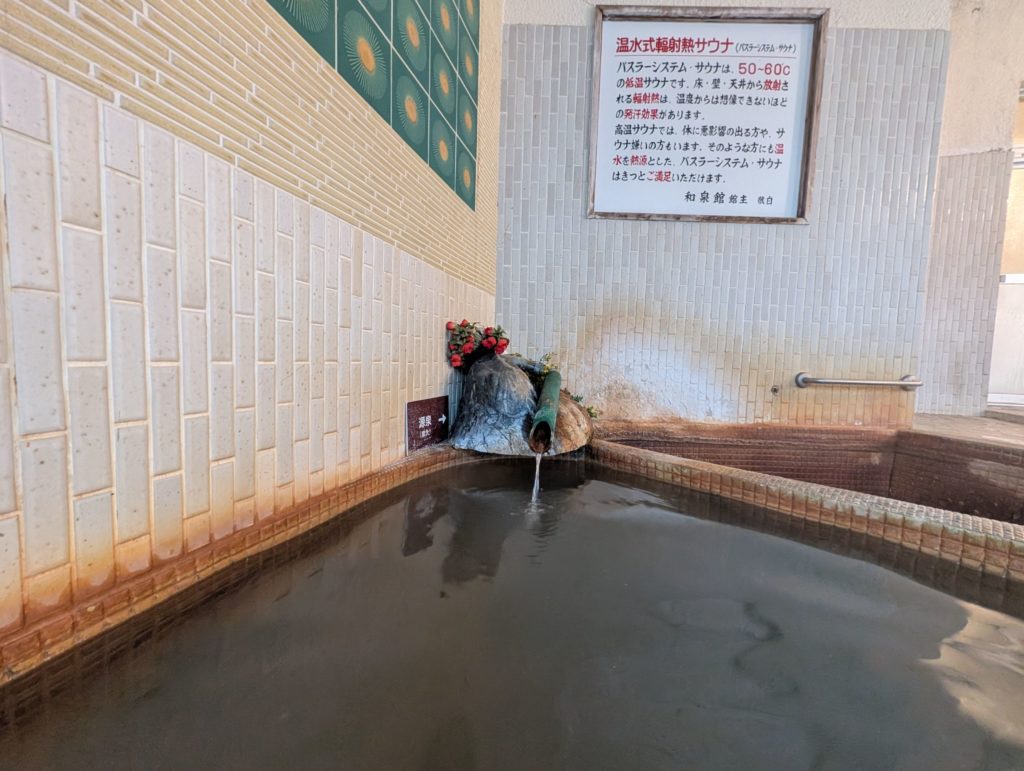
There is said to be an open-air bath, but on this day it wasn’t available—either it was closed or not accessible for day-use guests—so I enjoyed the indoor baths instead. Inside, there were three tubs: one fed directly by the source, a round bath with hotter water, and another bath that wasn’t filled at the time.
The source-fed bath had a clearly brownish color, while the hotter bath was completely clear. According to the inn’s website, the hotter bath uses diluted source water, but at first glance it almost looked like heated well water or tap water. The inn also promotes the use of “natural mineral ceramic” materials in the bath, which left me feeling a bit skeptical.
That said, the source bath itself was excellent. With a total mineral content of 3,158 mg/kg, a pH of 6.8, and a source temperature of 33.5°C, the water quality and lukewarm temperature were irresistible. The water had a strong metallic scent, and I felt like I could soak forever—it really seemed to work deeply on the body. Strangely enough, though, the local regulars hardly used the source bath at all. Instead, they soaked in the hotter bath, chatting away happily. Maybe that mysterious ceramic bath was the real attraction.
I later realized that the open-air bath apparently has a great atmosphere—I may have simply missed the exit to the outside. What a waste. I also found out afterward that the spring water is drinkable, and that Izumikan even uses it in their tempura batter. It’s a quiet, somewhat rustic inn, but if I ever need a place to stay around Kiyosato or Nobeyama, it’s definitely somewhere I’d like to return to.